🚀 30-Second Summary (TL;DR)
Private Agent architectures provide closed-loop, autonomous systems that keep sensitive corporate data within company borders, shielding it from the risks of public AI models. By leveraging RAG technology and agentic workflows, enterprises can boost operational efficiency by up to 40% without compromising data security.
The Age of Data Sovereignty: Privacy-First Private Agent Architectures for the Enterprise
In today's corporate landscape, the cost of a data breach isn't just a blow to reputation—it's a financial catastrophe averaging $4.45 million in direct losses. Every day, employees unknowingly upload critical company secrets, proprietary code blocks, and financial projections into public AI models. This effectively donates your intellectual property to a global training pool. For the modern enterprise, the solution isn't to ban AI, but to evolve toward Private Agent architectures that keep data strictly within corporate boundaries.
Private Agent Architecture: Governing Data Instead of Just Training It

Visual: Private Agent Architecture - Governing Intelligence Without Data Leakage
Unlike traditional LLM (Large Language Model) usage, Private Agent systems are not static repositories where data is hard-coded into the model. At their core lies RAG (Retrieval-Augmented Generation) technology. Think of this architecture not as an all-knowing genius who has memorized everything, but as a hyper-intelligent research assistant who holds the exclusive keys to your private library.
The Technical Blueprint and Security Layers
Building a Private Agent involves several mission-critical processes:
- Data Chunking: Massive documents are broken down into small, meaningful segments without losing context.
- Embedding: These segments are converted into numerical coordinates (vectors) that preserve semantic relationships.
- Vector Databases: Instead of traditional tables, data is stored in specialized repositories based on semantic proximity.
- Guardrails: Strict enterprise protocols are defined to dictate which data the system can access and what actions it is authorized to take.
This approach eliminates "hallucinations"; the AI only generates responses by referencing your verified documents, providing fully traceable citations.
Agentic Workflows and Multi-Agent Systems
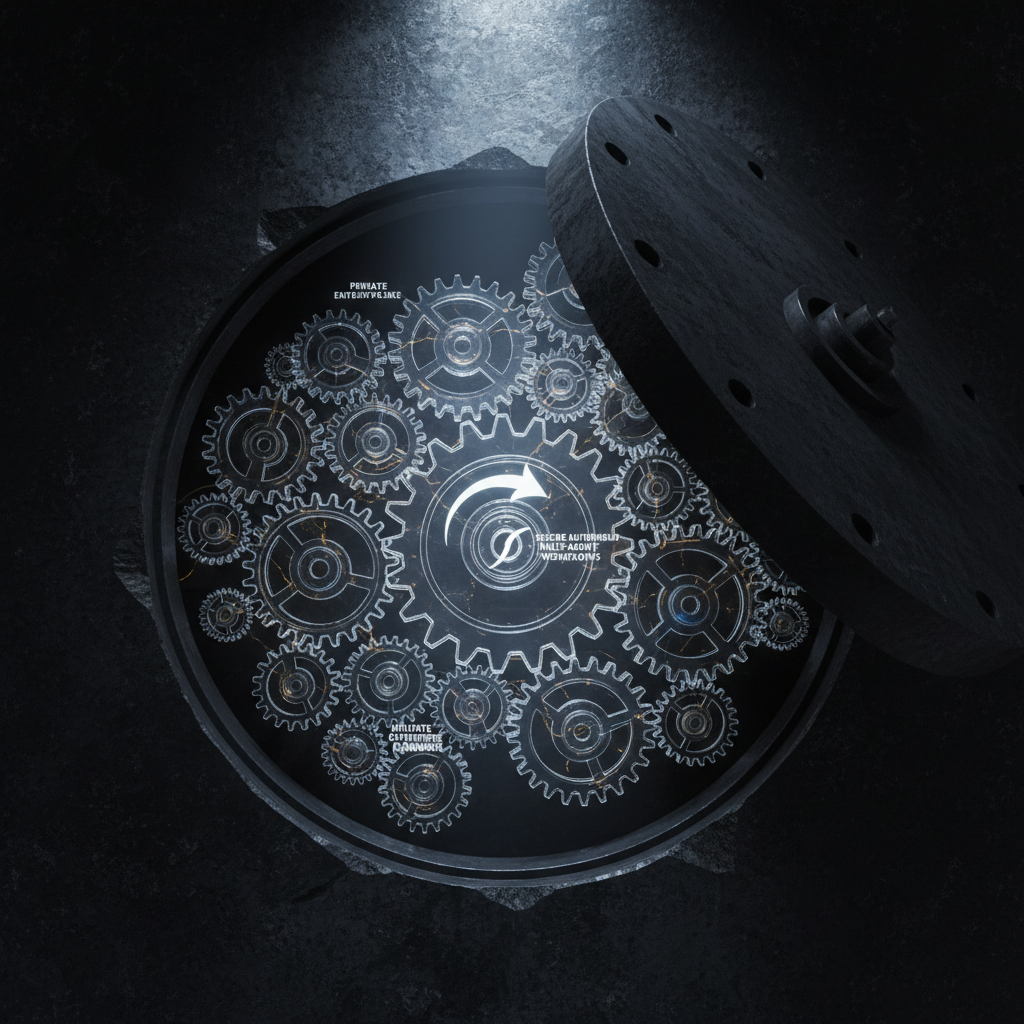
Visual: From Chatbots to Autonomous Agentic Workflows
The defining characteristic that separates a Private Agent from a simple chatbot is its Agentic Workflow capability. While static systems merely answer questions, autonomous agents plan toward a goal, utilize tools (APIs, ERP, CRM), and execute end-to-end processes.
Advanced platforms like Vebende enable these agents to operate 24/7. For instance, in a logistics scenario we implemented, the system doesn't just answer "Where is the ship?"; it detects a delay, drafts the necessary customs documentation, and triggers automatic notifications to the relevant departments. In Multi-Agent systems, one agent analyzes the data, a second formats it into a report, and a third performs a security audit.
"In the future, corporate value will not be measured by raw data alone, but by the efficiency of the closed-loop systems that transform that data into autonomous power."
Market Comparison: Why Off-the-Shelf Solutions Aren't Enough

Visual: Market Benchmarking - Why Data Sovereignty Wins
Tools like Microsoft Copilot Studio offer excellent standardized features within a Public Cloud infrastructure. However, for highly regulated sectors like finance, healthcare, and defense, data sovereignty is non-negotiable. Private Agent architecture takes the cloud-first approach a step further by deploying the system directly on your hardware (On-Premise) or within your isolated Virtual Private Cloud (VPC).
Case Study: For a mid-sized software house, we deployed the Llama 3 model on local servers. This led to a 40% increase in developer productivity regarding technical documentation queries and code optimization. This growth was measured by the reduction in support ticket resolution times and the minimization of manual doc reviews. Most importantly, not a single line of proprietary code ever left their network.
The Strategic Roadmap: Building Your Data Fortress
At NextFactor, we believe a successful Private Agent strategy requires three vital steps:
- Data Classification: Distinguishing between data that must remain local (the "crown jewels") and data that can be processed by general models.
- Model Optimization: Fine-tuning open-source models like Mistral or Llama 3 to align with your corporate language and documentation structure.
- Integration and Scaling: Ensuring the agent isn't just a UI, but is securely connected to Slack, WhatsApp, corporate email, and ERP systems via secure gateways.
Conclusion: The New Standard for Enterprise Intelligence
By 2025, AI adoption will move from being a competitive advantage to a fundamental requirement for survival. However, those who fail to protect their data risk turning their greatest asset into the fuel that trains their competitors. Building a Private Agent architecture—possessing its own memory, closed to the outside, yet fully operational internally—is the only way to build the data fortresses of the future.
🚀 Transform Your Data Security into Autonomous Power
Meet our expert team to develop custom, closed-loop AI architectures and autonomous workflows for your company. Let’s explore solutions that eliminate data leak risks entirely.
Schedule Your AI Strategy Analysis →🚀 Ready to Scale Your Business with AI?
At NextFactor AI, we develop brand-specific autonomous solutions tailored to your needs.
Get a Quote Now →