
Autonomous Biofactories: Coding the Future of Fuel with AI and Biosensors
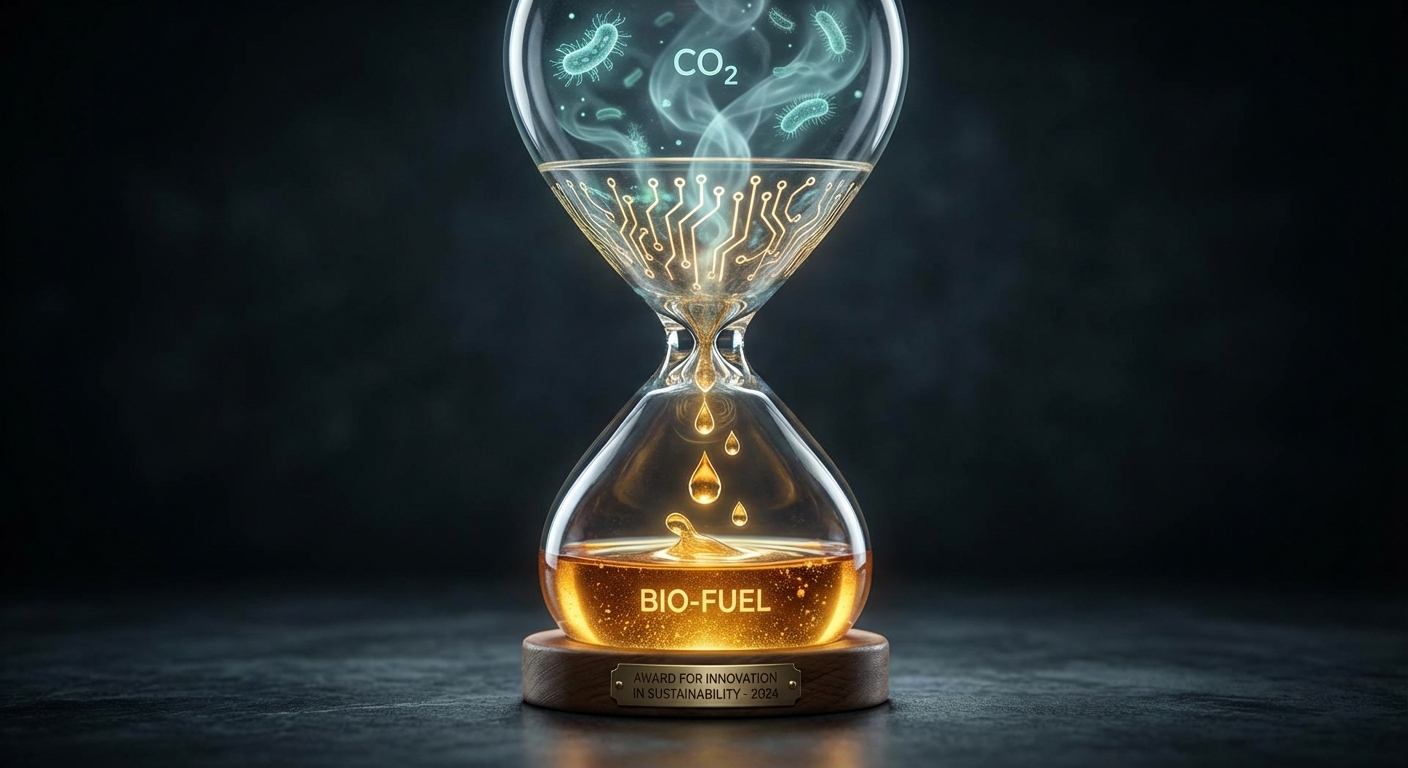
When you imagine the energy facilities of the future, you might see towering smokestacks or endless fields of solar panels. However, the true revolution is happening within a microscopic world, reflected on a lab technician’s monitor. Today, synthetic fuel production is evolving from a purely chemical process into a 'software architecture' where biology is managed by Artificial Intelligence (AI). We are no longer just building reactors; we are designing 'thinking' microorganisms that programmatically convert carbon into high-performance fuel.
The Cellular Cockpit: Real-Time Data via Genetically Encoded Biosensors
In traditional bioprocessing, understanding how much fuel a bacterium produced required waiting for the end of the cycle. This is like trying to understand how a jet engine works by reading the black box only after the plane has crashed. Genetically encoded biosensors are fundamentally shifting this paradigm. These sensors act as molecular 'dashboards' embedded directly within the cell.
Visual: Biosensors convert intracellular sugar and fuel levels into light signals with millisecond precision, creating a 'live stream' for AI analysis.
For instance, FRET (Förster Resonance Energy Transfer) based sensors report the concentration of specific molecules through light intensity. If 'fuel precursors' are accumulating but the final product isn't forming, the AI detects this signal instantly. This provides engineers with a real-time 'heat map' of metabolic bottlenecks, allowing for immediate intervention.
The Digital Foreman: Agentic Workflows and Autonomous Decision-Making
Who manages this massive influx of biological data? This is where Agentic Workflows come into play. Think of these systems not as static software waiting for a command, but as 'digital foremen' capable of autonomous decision-making. When an agent receives data from a biosensor indicating that the 'metabolic load is too high,' it doesn't wait for human approval to adjust the system.

Visual: Autonomous systems (Agentic Workflows) use Bayesian Optimization to select the highest-yielding genetic sequences from billions of permutations in seconds.
These agents operate using Bayesian Optimization—a mathematical method that, instead of blind trial-and-error, learns from previous failures to calculate the most logical next step. This autonomous framework shrinks R&D cycles that used to take years into mere weeks. Engineers are no longer manually mixing test tubes; they are now the strategists designing the logic for these digital agents.
The Rubisco Problem: Coaching the 'Lazy Worker'
Carbon fixation lies at the heart of synthetic fuel. In nature, the most common enzyme for this task, Rubisco, acts like a 'lazy' and error-prone worker. While trying to capture carbon from the atmosphere, it often mistakenly grabs oxygen, slowing the entire process. AI is essentially equipping this slow worker with a 'motorized exoskeleton.'

Visual: AI-powered protein engineering can optimize the kinetic parameters of the Rubisco enzyme, increasing carbon capture capacity by up to 40%.
Through heterologous pathway engineering, we insert genetic routes into a bacterium that don't exist in its natural state. AI simulates whether these new pathways will clash with the cell's primary metabolism using digital twins. By optimizing the kinetic parameters (Kcat and Km) of enzymes like Rubisco, we transform bacteria into high-efficiency 'carbon-eating' machines.
Tangible Impact: What Does a 25% Yield Increase Mean?
Technical projections suggest that this AI-bio integration could push production efficiency from current 2-3% levels to 25%. For the end-user, this is a game-changer. If we can reach these efficiency levels, the cost of Sustainable Aviation Fuel (SAF)—currently thousands of dollars more than traditional jet fuel—could reach parity with fossil fuels. It means preserving our planet without skyrocketing the price of an international flight.
Geopolitical Chess: The Sovereignty of Carbon
Scientific efficiency brings strategic freedom. Synthetic fuels are not just an environmental project; they are a declaration of energy independence. To produce energy, you no longer need oil reserves; you only need a robust AI infrastructure and bioreactors that capture carbon from the air. This technology shifts energy geopolitics from being 'resource-driven' to 'technology-driven.'
At NextFactor AI, we build the 'intelligence layer' used to manage these complex biological systems. We translate intricate heterologous pathway data into concrete industrial strategies for investment. The future of energy isn't buried underground in fossil fuels; it’s hidden within the algorithmic architecture of the cell.
🚀 Lead the Biotech and AI Transformation
NextFactor AI optimizes complex bioprocesses with autonomous systems and Agentic Workflow solutions. Shorten your path from lab to market—schedule a strategic analysis with us today.
Get a Proposal Now →