
🚀 30-Second Summary (TL;DR)
Model Context Protocol (MCP) is a revolutionary open standard that enables LLMs to connect to external data sources and tools via a secure, standardized JSON-RPC architecture. This guide explores MCP’s technical depth, its role in agentic systems, and the critical security risks involved.
Breaking Silos: A New Architectural Era in LLM Integration with Model Context Protocol (MCP)
Until recently, the primary bottleneck in enterprise AI projects wasn't the model's intelligence—it was how that intelligence accessed the data it needed. Every new data source, whether a SQL database or a Jira board, brought a headache of new API documentation, custom authorization layers, and endless 'glue code.' Anthropic’s Model Context Protocol (MCP) brings discipline to this chaos. By introducing a standardized framework, it transforms LLMs from isolated black boxes into active, data-driven participants in your ecosystem.
For developers, this means moving away from bespoke 'adapter' scripts for every application. Instead, you expose data once using the MCP standard, making it instantly accessible across the entire ecosystem. This isn't just a convenience; it is the fundamental infrastructure required for Agentic Workflows and autonomous systems to reach their true potential.
Architectural Deep Dive: The Host, Server, and Client Triad

Visual: The interaction between MCP Host, Server, and Client layers.
MCP adapts the traditional client-server model to the specific needs of LLM context. The brilliance lies in how it decouples security and authorization:
- MCP Host: The main application consuming the context (e.g., Claude Desktop, IDEs, or custom Python-based agents).
- MCP Server: A module that exposes data or capabilities (tools) using the standardized JSON-RPC 2.0 protocol.
- MCP Client: The protocol layer residing within the Host that manages secure sessions with the Server.
The true power of this architecture is its ability to unify local and remote resources under a single abstraction layer. For an LLM, a local sqlite-server and a remote slack-server become identical: simply two accessible 'context sources.'
"Show, Don't Tell": Solving Real-World Data Integration Pain

Visual: Overcoming data silos and formatting inconsistencies.
In the industry, the claim "we've connected all our data" is often superficial. In practice, you hit format friction: Database X uses Unix Timestamps, while API Y sends ISO 8601. When an LLM tries to merge these, it often hallucinates or unnecessarily bloats the context window.
In our past projects, the biggest hurdle in merging 14 different data sources was the model’s inability to distinguish between live and archived data. MCP solves this via Metadata Definition standards. It allows us to present the model with not just the content, but its quality—freshness, reliability, and schema structure.
Technical Implementation: A Practical Look
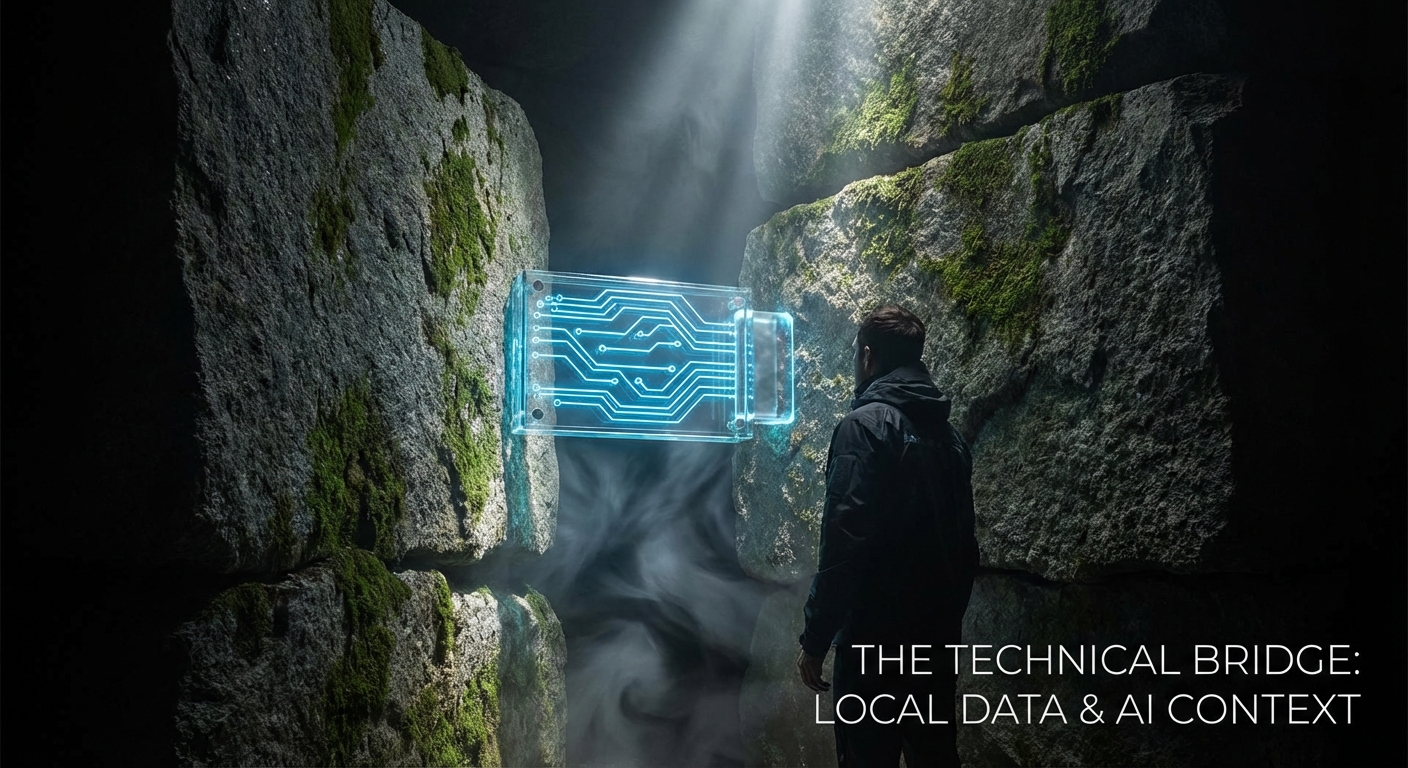
Visual: Configuring MCP servers for local and cloud integration.
Let's move from theory to practice. Connecting Claude Desktop to a local file system or an external API happens within the claude_desktop_config.json file:
{
  "mcpServers": {
    "local-research-tool": {
      "command": "npx",
      "args": [
        "@modelcontextprotocol/server-everything",
        "/Users/admin/documents/research-folder"
      ]
    },
    "github-integration": {
      "command": "npx",
      "args": ["@modelcontextprotocol/server-github"],
      "env": {
        "GITHUB_PERSONAL_ACCESS_TOKEN": "YOUR_TOKEN_HERE"
      }
    }
  }
}
This configuration does more than grant 'read' access. It empowers the LLM with 'tools' to analyze directory hierarchies and autonomously manage GitHub issues. This marks the transition from models that merely predict text to models that understand structure and take action.
The Dark Side: Risks and Limitations
Every technological leap introduces new vectors for failure. MCP is not a silver bullet; it carries several critical risks:
- Security and Isolation: Granting an LLM Local File Access opens the door to data exfiltration if the model falls victim to 'prompt injection' attacks.
- Context Window Bloat: Every active MCP server claims a portion of the context window. Overloading a model with too many tools can degrade its focus and spike token costs.
- Latency: An autonomous agent fetching data from five different MCP servers sequentially can lead to a sluggish, frustrated user experience.
Conclusion: MCP as a Strategic Competitive Advantage
MCP is more than a technical protocol; it is a major step toward data democratization. By liberating enterprise data from silos and making it available to autonomous systems, organizations can achieve a logarithmic increase in operational speed.
At NextFactor AI, we integrate this architecture at the core of our projects to build more than just 'chatbots'—we build secure, scalable Agentic AI ecosystems. If you want your systems to do more than talk and start actually 'working,' MCP integration is no longer optional; it’s a requirement.
Build the Autonomous Future Today
Let’s define your technical roadmap to transform company data into strategic MCP-standard assets.
Request a Technical Audit →🚀 Ready to Scale Your Business with AI?
At NextFactor AI, we develop custom autonomous solutions tailored to your brand.
Get a Quote Now →