🚀 TL;DR: 30-Second Summary
AMD is directly challenging NVIDIA's dominance in the AI chip market with a strategic $5 billion investment in Anthropic and a massive 2-gigawatt AI chip supply deal. This bold move, leveraging AMD's Helios rack systems and Zen 6 EPYC Venice processors, promises to redefine market dynamics by delivering unparalleled performance and integrated solutions.
AMD's $5 Billion Bet on Anthropic: A Direct Challenge to NVIDIA's AI Chip Dominance
Artificial intelligence has become one of the most critical technologies, fundamentally transforming our world. At the heart of this transformation lies the fierce competition for computational power provided by silicon chips. This market, long dominated by NVIDIA, is now facing one of its biggest challenges yet.
Advanced Micro Devices (AMD) is positioning itself as a serious contender to NVIDIA's leadership with a strategic $5 billion investment in Anthropic, a leading player in the AI market, coupled with a significant chip supply agreement.
This bold move includes Anthropic's commitment to utilize AMD's next-generation AI chips, consuming up to 2 gigawatts of power, starting in the first half of 2027. How will this colossal agreement reshape the dynamics of the AI chip market, and is NVIDIA's reign truly being shaken? Let's dive deep into this escalating chip war.
🚀 The New Front in the Chip War: AMD and Anthropic's Audacious Alliance
Image: 🚀 The New Front in the Chip War: AMD and Anthropic's Audacious Alliance
The insatiable demand for large language models like Anthropic's Claude is placing immense pressure on existing infrastructure. This 'unquenchable' need for computational power is pushing data center capacities to their limits, accelerating the requirement for scalable solutions.
- $5 Billion Commitment: AMD will invest up to $5 billion in Anthropic, contingent on deployment milestones. This investment isn't just financial support; it also has the potential to secure Anthropic's future data center infrastructure, laying the groundwork for a long-term collaboration. (Source 1)
- 2 Gigawatts of Chip Procurement: Through this agreement, Anthropic has committed to using AMD Instinct MI450 Series GPUs and AMD Helios rack-scale solutions. The first gigawatt-scale deployment is planned to begin in the first half of 2027. This immense capacity is critical for meeting Claude's continuously increasing and multi-step 'Agentic Workflow'-based computational power requirements. (Source 2)
As AMD CEO Lisa Su has articulated, large-scale AI deployments demand long-term strategic planning. This move is at the core of AMD's strategy to expand its presence in the rapidly growing AI chip market and offer developers a powerful, integrated alternative to NVIDIA.
⚡ AMD's Power Play: Helios and Zen 6 Take on NVIDIA
Image: ⚡ AMD's Power Play: Helios and Zen 6 Take on NVIDIA
AMD isn't limiting itself to just investments in this market share battle; it's also showcasing its technological prowess.
Helios: The Future of AI Training
AMD's "Helios," touted as the industry's highest-performing AI rack system, is specifically engineered to train and run the most demanding models at a "gigawatt scale." This aims to provide the intense computational power required for autonomous systems and complex AI workloads. Helios's performance metrics are reportedly turning heads in the market, with claims of surpassing NVIDIA's ambitious Vera Rubin system across several parameters. (Source 5, 6)
And its customer list is equally impressive: alongside Anthropic, tech giants like OpenAI, Microsoft, Meta, and Oracle are reportedly planning to utilize Helios systems. Microsoft CEO Satya Nadella's announcement of expanding Azure infrastructure with Helios demonstrates AMD's determination to evolve beyond merely a chip manufacturer to become an end-to-end AI ecosystem provider. (Source 5, 6, 7)
EPYC Venice and Instinct MI450: Next-Gen Computational Power
Another key player in AMD's ascendancy is its next-generation processors. Based on the Zen 6 architecture, the 256-core, 2nm EPYC Venice CPUs are specifically optimized for "Agentic AI" workloads. Agentic AI refers to advanced AI models that execute multi-step logical processes, continuously access databases, make complex decisions, and perform tasks autonomously. EPYC Venice claims to outperform NVIDIA's Vera CPUs in such "Agentic Workflow" scenarios, both in single-core performance and overall efficiency. (Source 3, 8)
Anthropic's choice of Instinct MI450 Series GPUs further solidifies AMD's assertion of leadership in AI computational power. These chips aim to maximize the performance of AI-powered autonomous systems by offering the high bandwidth and low latency required for large language model training and inference.
🚧 Is NVIDIA's Fortress Cracking? Strategic Moves and Counter-Attacks
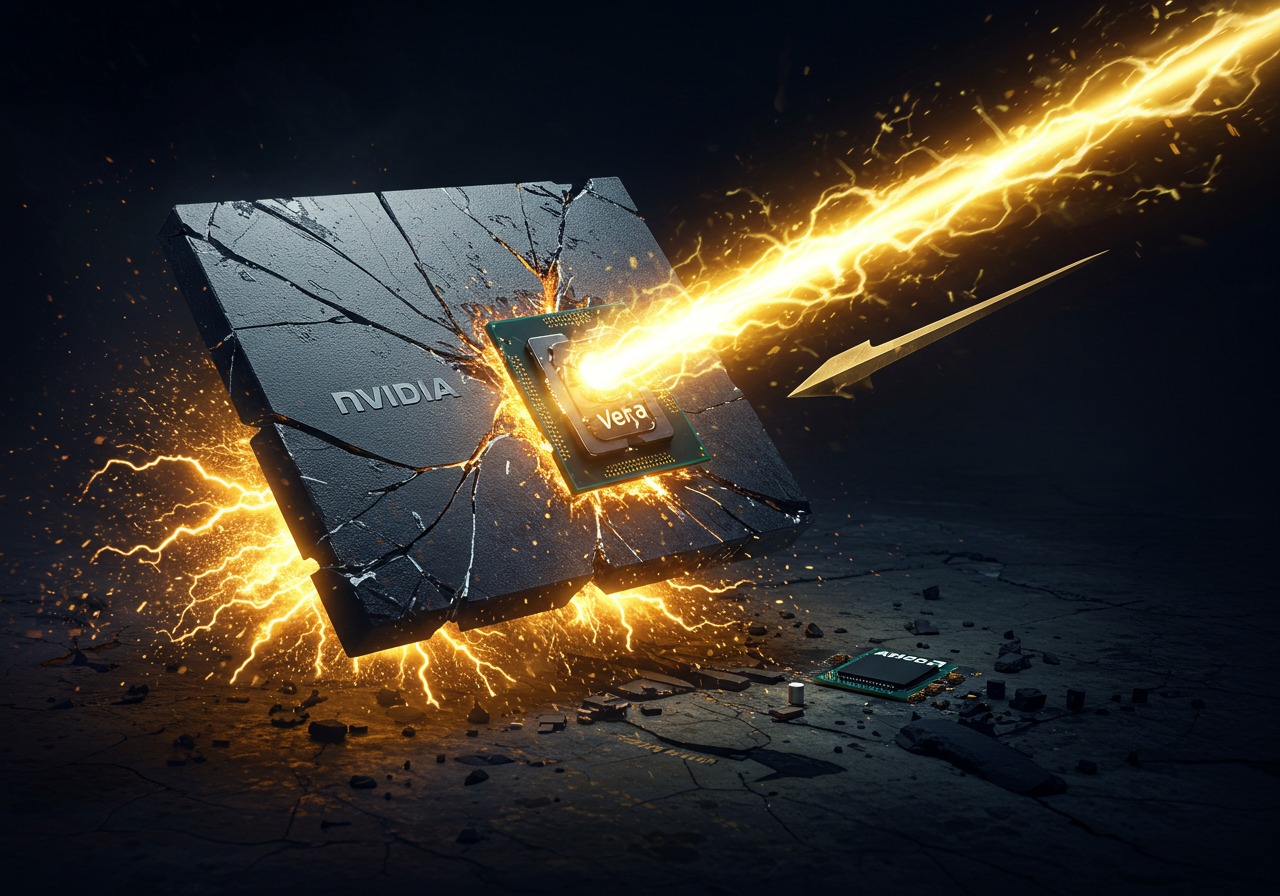
Image: 🚧 Is NVIDIA's Fortress Cracking? Strategic Moves and Counter-Attacks
Of course, NVIDIA isn't prepared to relinquish its throne in the AI chip market so easily. As the undisputed leader in this market for many years, NVIDIA has accelerated its strategic moves in response to AMD's aggressive offensive.
New Battlegrounds with Vera CPU
NVIDIA isn't just maintaining its dominance in GPUs; it's also challenging AMD and Intel in the CPU space with its data center CPU, 'Vera.' It's known that Vera chips have been delivered to major customers like OpenAI. This move is part of NVIDIA's strategy to seize leadership across all AI server systems, not just through GPUs, and to offer fully integrated solutions. (Source 4)
Strategic Memory Supply Agreements: Securing the Supply Chain
However, one of NVIDIA's most strategic maneuvers has been securing the supply of critically important HBM4 (High Bandwidth Memory). Through long-term agreements with leading memory manufacturers like South Korea's SK Hynix, NVIDIA isn't just guaranteeing its own memory needs; it's also potentially limiting rivals' access to similar strategic components by managing access to HBM4. This demonstrates a shrewd step, indicating that supply chain control is as decisive a factor in competition as technological superiority.
🌌 The Future of AI: Who Will Win, and What Awaits Us?
According to AMD CEO Lisa Su, the AI chip market is projected to reach a staggering $1.4 trillion by 2030. This figure is equivalent to the size of the entire semiconductor market today! The battle to claim a slice of this enormous pie will undoubtedly be breathtaking.
With the dawn of the 'Agentic AI' era, AI systems will need to become more complex and autonomous, capable of executing multi-step logical processes, continuously accessing databases, making dynamic decisions, and performing tasks autonomously. This will dramatically increase the demand for thousands of powerful GPUs and optimized CPUs.
Market competition will no longer be limited to just GPUs; it will intensify across CPUs, rack-scale systems, and the entire AI infrastructure. Developers turning to alternatives beyond NVIDIA will lead to market diversification and, consequently, faster innovation. This competition is one of the most crucial factors shaping the future of AI innovation.
🎯 Is NVIDIA's Reign Shaking? Market Dynamics Redefined!
AMD's $5 billion strategic investment in Anthropic is not merely a financial commitment but a bold stride directly challenging NVIDIA's undisputed leadership in the AI chip market. With its Helios system, EPYC Venice CPUs, and Instinct MI450 GPUs, AMD is building a formidable competitive edge in both performance and integrated solutions.
While NVIDIA strives to maintain its leadership with Vera CPUs and strategic HBM4 memory supply agreements, AMD's aggressive moves could fundamentally alter market dynamics. This fierce competition will further accelerate AI innovation, delivering next-generation, more powerful, and efficient AI infrastructures to the tech world.
In the coming years, it will be exciting to witness who emerges victorious in the AI chip market and which new, more advanced AI technologies and autonomous systems this intense rivalry will ultimately unleash. This cutthroat competition between companies will continue to be a foundational factor determining the speed, accessibility, and direction of innovation in the age of AI.
🚀 Ready to Scale Your Business with AI?
At NextFactor AI, we develop custom autonomous solutions for your brand. Schedule a free analysis consultation today.
Get a Quote Now →